Curio (noun) a rare, unusual, or intriguing object
Showing posts with label exposition. Show all posts

Saturday, February 29, 2020

Hobbies: an endangered species?


Their hobby might be practicing poses for a Le Penseur group photo.
#GreatRodinMoments

I read a couple interesting articles1 today and learned that hobbies are apparently on their last legs! One begins:
Too many kids let screen time and homework crowd out real pursuits. If you ask most young people today if they have any hobbies, you will receive one of four answers:

1. "No."

2. "What do you mean?"

3. "Yeah. I play video games/watch TV/watch movies."

4. "Yeah..." and then they may actually cite a hobby.

The fourth is the least common.
But where exactly is the line between an activity and a hobby?

Monday, May 27, 2019

Algorithms and the attention economy

Last week FiveThirtyEight published Where The Algorithms Can't Find You, an article about how the modern internet's cookies and web analytics funnel everyone toward the same content with "algorithms that think you only want to watch beauty tutorials, Avengers outtakes or product unboxings."

Presumably in response to this state of affairs, a few people have started websites that specifically serve up videos that other people aren't watching. Here's one of the author's favorites from Default Filename TV, a website that finds and plays random YouTube videos with names like DSC 3307:


The algorithms will never recommend a video like this because it doesn't look like anything people in general or the current viewer in particular already watch, and I think that's a problem.

Sunday, April 29, 2018

Opiod crisis, health care, false certainty


The New York Times published a thought-provoking article today about the opioid crisis and the healthcare industry's evolving response to it, but also about second chances and human nature.

Injecting Drugs Can Ruin a Heart. How Many Second Chances Should a User Get?
By Abby Goodnough, April 29, 2018

OAK RIDGE, Tenn. — Jerika Whitefield's memories of the infection that almost killed her are muddled, except for a few. Her young children peering at her in the hospital bed. Her stepfather wrapping her limp arms around the baby. Her whispered appeal to a skeptical nurse: "Please don't let me die. I promise, I won't ever do it again."

Ms. Whitefield, 28, had developed endocarditis, an infection of the heart valves caused by bacteria that entered her blood when she injected methamphetamine one morning in 2016. Doctors saved her life with open-heart surgery, but before operating, they gave her a jolting warning: If she continued shooting up and got reinfected, they would not operate again.

With meth resurgent and the opioid crisis showing no sign of abating, a growing number of people are getting endocarditis from injecting the drugs — sometimes repeatedly if they continue shooting up. Many are uninsured, and the care they need is expensive, intensive and often lasts months. All of this has doctors grappling with an ethically fraught question: Is a heart ever not worth fixing?
I highly recommend reading the full article. A few thoughts below.

Sunday, June 18, 2017

A few thoughts on milestones

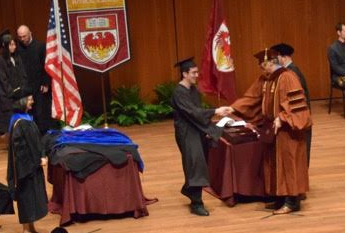
After three years of work, I completed my master's program and received my diploma at a nice ceremony last weekend. I enjoy graduations: the celebration, the sense of closure, the costumes, and the speakers, whose commentary adds a modern sensibility to old traditions.

Saturday, August 6, 2016

Amateur electrician (half-)hour

A few days ago, my late-night reading session was disturbed by a very large, very loud Musca domestica flitting around the ceiling fan, determined to push its face all the way through the frosted glass of my new LED bulb to feast on its tasty electronic innards.

Bzzzzzzzzzz

Determined to take matters into my own hands, I grabbed a nearby handkerchief and began flailing wildly at the intruder. A few things happened at once:
  1. The fly escaped between the spinning blades of my ceiling fan (really);
  2. The handkerchief wrapped itself around the weighted end of the light's pull-chain;
  3. The light went out with a crack (and I put up a blackout curtain at night, so it was very dark);
  4. Something whizzed by my arm and crashed into the ground.

Wednesday, June 8, 2016

Future historians, rock & roll, narratives


The record that just might go gold galactically

The New York Times magazine recently published a fun article about which iconic rock artists might still be remembered 300 years hence, but also about how it's not facts but narratives that shape history. Here's an excerpt for flavor:
I have no data on this, but I would assert that if we were to ask the entire population of the United States to name every composer of marching music they could think of, 98 percent of the populace would name either one person ([John Philip] Sousa) or no one at all. There’s just no separation between the awareness of this person and the awareness of this music, and it’s hard to believe that will ever change.

Now, the reason this happened — or at least the explanation we’ve decided to accept — is that Sousa was simply the best at this art. He composed 136 marches over a span of six decades and is regularly described as the most famous musician of his era. The story of his life and career has been shoehorned into the U.S. education curriculum at a fundamental level. (I first learned of Sousa in fourth grade, a year before we memorized the state capitals.) And this, it seems, is how mainstream musical memory works. As the timeline moves forward, tangential artists in any field fade from the collective radar, until only one person remains; the significance of that individual is then exaggerated, until the genre and the person become interchangeable.
I'd say it doesn't stop with musical memory, though: this is how almost all memory works.

Sunday, February 28, 2016

Google, the perfect team, and internet comments

The New York Times published What Google Learned From Its Quest to Build the Perfect Team earlier this week, and it's worth a read. My favorite part:
What Project Aristotle has taught people within Google is that no one wants to put on a ‘‘work face’’ when they get to the office. No one wants to leave part of their personality and inner life at home. But to be fully present at work, to feel ‘‘psychologically safe,’’ we must know that we can be free enough, sometimes, to share the things that scare us without fear of recriminations. We must be able to talk about what is messy or sad, to have hard conversations with colleagues who are driving us crazy. We can’t be focused just on efficiency. Rather, when we start the morning by collaborating with a team of engineers and then send emails to our marketing colleagues and then jump on a conference call, we want to know that those people really hear us. We want to know that work is more than just labor.
The article reinforces some of the things I've been mulling over, but what I actually want to talk about are the most common reactions other people have had to the article, based on its comment section.

Sunday, February 14, 2016

A few thoughts on "work-life balance"

The strange draw of SANS SERIF CAPS

As of this month I'm halfway through my Master's program, and I've been thinking a bit more about what comes afterward. People have already started to ask what industries and companies I'm interested in, but those aren't quite the right questions for me. Where I apply myself is important, but so is how I go about it.

I just revisited Lotte Bailyn is Redefining the Rules of Work and Family, which is a worthwhile read. Here's the hook:
Lotte Bailyn hates the phrase work–life balance. “Work–life” implies that the two exist in separate spheres. And “balance” implies that there’s a trade-off to be made.
Maybe that sounds too close to "you can have it all," which most people recognize as too idealistic, but I think there's an important point here. The goal shouldn't be to find a satisficing middle ground that gives up a little from here and a little from there. The goal should be to structure your life in a way that's sustainable, enjoyable, and fulfilling.

Wednesday, January 20, 2016

Smell the roses

"If you don't write it down, it doesn't exist." —Linda Ginzel

I used to do a lot of journaling. Even as recently as a couple of years ago, I'd write almost daily – certainly at least weekly – jotting down ideas, impressions, emotions, and the like as the mood took me. I wasn't really trying to keep a biographical record or preserve ideas or anything of the sort. It's more that the act of writing helped me process my thoughts, helped declutter my mind.